A Miele Rotary Ironing Press significantly improves laundry routines by offering professional-quality results on a variety of garments and linens, saving valuable time and effort compared to traditional ironing. These sophisticated appliances, like the Miele B990 or HM1680, feature a large, heated roller that feeds fabric through, dramatically reducing ironing time by more than half and delivering impeccably pressed fabrics with minimal physical exertion.
Understanding the Ironing Press: Why You Need One
An ironing press is an appliance designed to flatten clothes and fabrics using heat and pressure, offering a significant upgrade from a conventional handheld iron. Unlike traditional irons that require continuous manual gliding, an ironing press typically features a large, heated surface that clamps down on fabric, or in the case of a rotary iron, feeds fabric through a heated roller. This mechanism dramatically reduces ironing time and physical exertion, delivering crisp, professional finishes with minimal effort. Rotary ironing presses, like Miele’s models, are particularly adept at handling large, flat items such as bed linens, tablecloths, and curtains, as well as more intricate garments like shirts and trousers, by feeding them through a rotating heated cylinder.
The primary advantages of an ironing press over a traditional iron include superior speed, enhanced efficiency, and a more consistent finish across larger surface areas. These machines can cut down ironing time by more than half, making them indispensable for households with extensive laundry loads or for small businesses such as B&Bs and restaurants. The controlled and even application of heat and pressure also helps protect delicate fabrics from accidental scorching or uneven pressing, extending the life of your garments and linens.
Classifying Ironing Presses: Finding Your Perfect Match
Ironing presses come in various forms, each suited for different needs, but the rotary ironing press stands out for its unique operation and versatility. Rotary presses, also known as roller irons, feature a large, heated roller that rotates, pulling fabric through a heated plate. This continuous feed system allows for exceptionally fast and even pressing of a wide range of items.
By Size
- Mini/Compact: Typically smaller, tabletop models designed for occasional use or limited space. They are convenient for quick touch-ups but lack the capacity for large household items.
- Standard: Most home-use ironing presses fall into this category, offering a balance of size and functionality. Miele’s home rotary irons, while substantial when open, often feature clever fold-away designs. They are ideal for average to large laundry loads, providing a professional finish for everyday garments and linens.
- Large/Industrial: These heavy-duty machines are built for commercial environments, handling massive volumes of laundry. They are larger, more robust, and engineered for continuous, high-volume operation, often found in hotels or professional laundries.
By Operating Mechanism
|
Our Picks for the Best Ironing Press in 2026
As an Amazon Associate I earn from qualifying purchases.
|
||
| Num | Product | Action |
|---|---|---|
| 1 | Cricut EasyPress Mini Heat Press - for Pressing Small Objects Like Shoes, Stuffed Animals, Hats & More - 3 Heat Settings & Precision Tip - Ceramic-Coated Heat Plate - Compact & Lightweight - Zen Blue |

|
| 2 | BLACK+DECKER Easy Steam Compact Iron for Clothes, Automatic Shutoff, Nonstick Plate, Light Weight, 1200 Watts |
|
| 3 | The Quilted Bear Mini Steam Iron - Lightweight Mini Travel Iron for Effortless Quilting & Wrinkle-Free Clothes with Hard Shell Case - Travel Steamer Craft Press for Clothes & Crafts (Black) |
|
| 4 | DRFLASH 2-in-1 Steamer & Iron for Clothes,15s Fast Heat-up 1200W Portable Handheld Garment Steamer,Travel Size with Large Ceramic Heat Panel,Quick Wrinkle Removal,110V-120V |
|
| 5 | Calogy Mini Heat Press, Heat Transfer Machine, Constant Temp Control, Insulated Safety Base, Fits for Crafts, T-Shirt, Hat, Cap, Pillows(White Pink) |
|
| 6 | BLACK+DECKER Press & Steam 2-in-1 Iron and Steamer, 180% More Steam & One Temperature Technology, Ceramic Soleplate, Safe on All Fabric Types |
|
| 7 | Cricut EasyPress Mini™ LT - Mint Green - Mini Heat Press for Pressing Shoes, Baby Clothes, T-Shirts, & More - Easy to Use with a Single Setting - Precision Tip - Compact & Portable Mini Iron |
|
| 8 | Steamfast SF-623 Mid-Size Steam Press with Multiple Fabric Settings and Steam Burst Function, Black, 20.47" L x 17.16" W x 6.73" H |
|
| 9 | Steamfast SF-680 Digital Steam Press with Multiple Fabric Settings and Steam Burst Function,Stainless/Black |
|
| 10 | HTVRONT Heat Press Mini Heat Press Machine, Small Heat Press Portable Iron Press Machine for T Shirts, Hats, Heating Transfer Projects (Mint) |
|
- Manual: Requires the user to physically press a lever or handle to bring the heated plate down onto the fabric. These are typically flat presses and demand more manual effort.
- Semi-automatic: Often features foot pedal activation for the pressing action, freeing up hands to position fabric. Many Miele rotary irons fall into this category, using a foot pedal to engage the roller and heating plate.
- Automatic: These advanced machines may have sensors and programmable settings to automate parts of the ironing process, reducing user intervention significantly. While Miele’s rotary irons offer variable speeds and temperatures, the feeding process still requires user guidance.
Comparing Popular Ironing Press Types
Choosing the right ironing press depends heavily on your specific needs, the volume of laundry, and the types of fabrics you typically iron. Here’s a comparison of common ironing methods to highlight the unique advantages of a rotary ironing press.
| Feature | Handheld Iron | Flat Ironing Press | Rotary Ironing Press (e.g., Miele) |
|---|---|---|---|
| Speed/Efficiency | Slow, labor-intensive | Moderate, good for batches | Very fast, continuous feed, high throughput |
| Ease of Use | Requires skill & effort | Less effort than handheld, but still involves lifting & clamping | Very easy, hands-free fabric guiding with foot pedal |
| Results Quality | Good, but inconsistent | Very good, consistent | Excellent, professional, uniform finish |
| Fabric Handling | Versatile, but can damage delicate fabrics if not careful | Good for flat items, can struggle with complex shapes | Excellent for large flat items, open-end roller for shirts, gentle on delicate fabrics |
| Space Required | Minimal | Moderate | Significant when open, folds for compact storage |
| Ergonomics | Standing, repetitive motion | Seated or standing, less strenuous | Seated operation, greatly reduces fatigue |
| Cost | Low | Moderate | High (initial investment) |
| Best For | Small loads, quick touch-ups, intricate details | Medium loads, flat items, small garments | Large loads, bed linens, tablecloths, shirts, uniforms, professional finish |
The Miele Rotary Ironing Press excels in high-volume flatwork and offers an ergonomic, seated operation that drastically reduces physical strain compared to traditional methods. Its continuous feed mechanism and wide roller ensure uniform pressure and temperature, producing crisp, professional results every time.
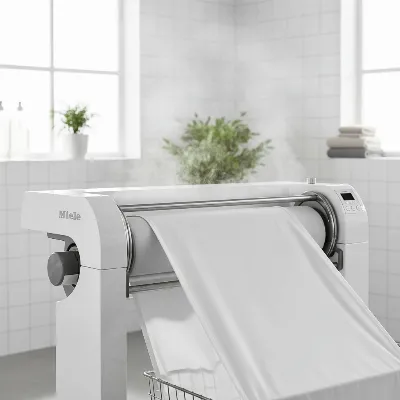 Miele Rotary Iron efficiently pressing a large bed sheet with crisp results
7 Important Factors to Consider When Buying an Ironing Press
Investing in an ironing press is a significant decision that can greatly enhance your laundry experience. To ensure you choose the perfect model, especially when considering a high-performance machine like a Miele Rotary Ironing Press, evaluate these seven crucial factors.
-
Budget: Ironing presses vary widely in price, from entry-level flat presses to premium rotary models. Miele Rotary Ironing Presses, known for their quality and durability, represent a higher upfront investment. Determine your budget early, balancing it against the desired features and expected longevity of the appliance. A higher initial cost can often translate to greater efficiency, professional results, and long-term savings on dry cleaning.
-
Usage Needs: Consider how often you iron and what types of items you typically press. If you frequently iron large quantities of bed linens, tablecloths, or numerous shirts, a rotary ironing press will offer unparalleled efficiency. For occasional use or very small items, a simpler, more compact press might suffice. The Miele Rotary Iron is particularly beneficial for those who seek a perfect finish on a regular basis.
-
Size and Space: Ironing presses, especially rotary models, require more space than a traditional ironing board. While Miele Rotary Irons often feature fold-away designs and wheels for easy storage, measure your available floor space when both open and closed to ensure a comfortable fit. Consider where it will be used and stored to maintain accessibility and convenience.
-
Features: Look for features that enhance usability, safety, and performance. Key features of Miele Rotary Ironing Presses include a wide roller (e.g., 34-inch/83cm), an open-end roller design for shaped garments, variable temperature and roller speed settings, foot pedal operation for hands-free control, a safety finger guard, and an emergency release. Steam functionality (available on models like HM1680) is also a significant advantage for tackling stubborn creases and achieving a crisp finish.
-
Durability and Quality: An ironing press is a long-term investment. Opt for reputable brands known for quality construction and durable materials. Miele, a German manufacturer, is highly regarded for its robust appliances built to last. Check for solid construction, high-quality heating elements, and resilient roller covers (like aramid needle felt cloth) that can withstand consistent use.
-
User Reviews and Reputation: Researching user reviews and expert opinions can provide valuable insights into real-world performance and potential drawbacks. Pay attention to feedback regarding ease of use, effectiveness on different fabrics, durability, and customer support. Miele Rotary Irons generally receive high praise for their professional results and time-saving capabilities, despite the initial learning curve for some users.
-
Warranty and Support: A comprehensive warranty and reliable customer service are crucial for any major appliance. Understand the warranty period, what it covers, and the availability of service and parts. Miele typically offers strong after-sales support, which adds to the trustworthiness of their products.
Top Miele Rotary Ironing Presses: Performance and Features
Miele offers a range of high-performance rotary ironing presses designed for both discerning home users and professional environments. While the specific model numbers may vary, the core performance characteristics and benefits remain consistent. We’ll focus on the capabilities typically found in Miele’s leading home-use rotary irons, such as the B990 and HM1680/HM16-83 series.
The Miele B990/B990E Rotary Ironing Press shows efficient, professional-grade dry pressing. This model is engineered with a 34-inch (83cm) wide roller that provides ample surface area for large items like bed sheets and tablecloths, allowing them to be pressed in a fraction of the time compared to traditional methods. Its open-end roller design is a standout feature, making it exceptionally versatile for awkwardly shaped garments such as shirts and blouses, which can be fitted over the end without needing to be folded. Operation is intuitive, primarily controlled by a foot pedal, which frees both hands to smoothly guide the laundry, ensuring precise placement and wrinkle-free results. The B990 features variable roller speed settings and multiple temperature settings (typically three, corresponding to international fabric care symbols for synthetics, wool/silk, and cotton/linen), allowing users to customize the ironing process for various fabric types. For safety, it includes a finger guard and an emergency release button. Its fold-away design with integrated wheels ensures convenient storage and easy maneuverability, making it practical for home environments despite its robust size.
The Miele HM1680/HM16-83 Rotary Steam Ironing Press builds upon the robust foundation of the B990 by integrating powerful steam functionality. The addition of steam significantly enhances wrinkle removal, as the moist heat helps to relax fabric fibers, allowing creases to be pressed out more effectively and quickly. This model also boasts the wide, open-end roller, foot pedal operation, variable roller speeds, and precise temperature controls. The continuous steam output, combined with the roller’s even pressure, ensures a consistently smooth and crisp finish across all laundry items. Users often report that the steam feature drastically cuts down ironing time, especially for heavily wrinkled fabrics, and provides a superior, long-lasting finish. Like the B990, the HM1680/HM16-83 also features a fold-away design and wheels, making it a versatile yet storable appliance for achieving professional results at home.
> “The Miele Rotary Iron has revolutionized how I approach laundry. It’s an investment, but the time saved and the professional finish on everything from tablecloths to shirts makes it absolutely worth it.” – Sarah M., Home Management Expert
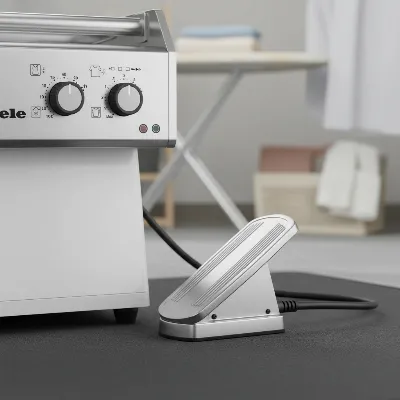 Close-up of Miele Rotary Iron controls with foot pedal and settings
Tips for Using and Maintaining Your Ironing Press
To maximize the performance and longevity of your Miele Rotary Ironing Press, proper usage and diligent maintenance are key. Following these tips will ensure you get the best results every time and extend the life of your valuable appliance.
Safe and Effective Usage
- Read the Manual: Always start by thoroughly reading your specific model’s instruction manual. This will familiarize you with its unique features, safety warnings, and optimal operating procedures.
- Pre-Dampen Fabrics (if no steam): For models without a steam function (like the B990/B990E), pre-dampening your laundry slightly can significantly improve results, especially on stubborn wrinkles. Miele washers often have an “Iron Dry” cycle that leaves the perfect amount of moisture.
- Adjust Settings: Select the appropriate temperature and roller speed for your fabric type. Delicate fabrics require lower temperatures and slower speeds, while cottons and linens can handle higher heat and faster speeds. Always test on an inconspicuous area first if unsure.
- Feed Evenly: Use both hands to guide the fabric smoothly and evenly into the roller. The foot pedal allows you to control the roller’s movement, keeping your hands free for precise placement. The open-end roller is perfect for fitting odd-shaped items like shirt sleeves.
- Avoid Overlapping: Try to avoid overlapping thick seams or multiple layers of fabric excessively, as this can lead to uneven pressing or stress on the roller.
- Utilize the Hanging Bar: Many Miele models feature a swing-out bar. Use this to hang freshly ironed items immediately, allowing them to cool and set without developing new creases.
- Safety First: Always use the finger guard and be mindful of the heated plate. In case of an emergency, utilize the emergency release button to quickly disengage the roller.
Maintenance for Longevity
- Clean the Roller and Heating Plate: Regularly wipe down the roller and heating plate once they have cooled. Use a soft, damp cloth to remove any residue from starch or fabric softeners. For stubborn buildup, consult your manual for recommended cleaning agents.
- Check Roller Cover: The roller is typically covered with a durable aramid needle felt cloth. Inspect this cover periodically for wear and tear. If it becomes damaged or excessively dirty, it may need to be replaced to maintain optimal ironing performance.
- Descaling (Steam Models): If your Miele Rotary Iron has a steam function (HM1680/HM16-83), descaling is crucial to prevent mineral buildup and maintain efficient steam production. Follow the manufacturer’s instructions for descaling, typically using a specialized descaling agent at recommended intervals, depending on your water hardness.
- Proper Storage: When not in use, fold the ironing press into its compact storage position and utilize its wheels to move it to a safe, dry location. This protects the appliance from damage and frees up floor space.
- Avoid Harsh Chemicals: Do not use abrasive cleaners, scouring pads, or harsh chemicals on any part of the ironing press, as these can damage surfaces and coatings.
By adhering to these usage and maintenance guidelines, your Miele Rotary Ironing Press will continue to deliver excellent, professional results for many years.
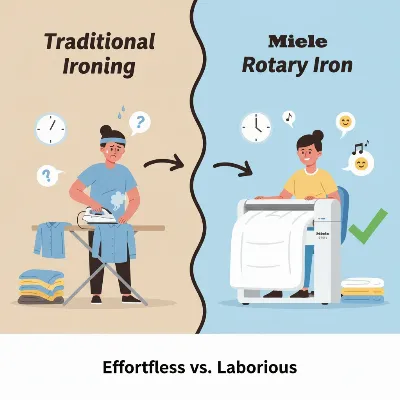 Efficiency comparison between traditional iron and Miele Rotary Iron
Conclusion
The Miele Rotary Ironing Press stands as a testament to German engineering, offering an unparalleled solution for achieving crisp, professional laundry finishes with remarkable efficiency. Whether you’re battling mountains of bed linens, striving for perfectly pressed shirts, or managing a small commercial operation, this appliance dramatically reduces the time and effort typically associated with ironing. Its hands-free foot pedal operation, wide open-end roller, and precise temperature and speed controls provide a versatile and ergonomic experience, while steam functions on models like the HM1680 further enhance wrinkle removal.
While the initial investment for a Miele Rotary Ironing Press is significant, its robust construction, long-term durability, and the sheer quality of its results underscore its value. For those who prioritize efficiency, a flawless finish, and a more comfortable ironing process, the Miele Rotary Iron is not just an appliance; it’s an indispensable addition to a modern home or business. Are you ready to improve your ironing routine and embrace the era of effortless perfection?
Frequently Asked Questions
What makes a Miele Rotary Ironing Press different from a steam iron?
A Miele Rotary Ironing Press uses a rotating, heated roller to press fabrics, offering a continuous feed system that provides uniform heat and pressure across large items quickly. In contrast, a traditional steam iron is a handheld device that requires manual gliding and applies heat and steam over a smaller area, demanding more time and physical effort, especially for big loads.
Can I iron all types of fabrics with a Miele Rotary Iron?
Yes, Miele Rotary Irons are highly versatile. With variable temperature settings and adjustable roller speeds, they can safely press a wide range of fabrics, from delicate synthetics and silks to robust cottons and linens. Always refer to the fabric care label and test on an inconspicuous area first, adjusting settings as needed for optimal results.
Is it difficult to learn how to use a Miele Rotary Iron?
While there might be a slight learning curve to master the feeding technique, many users find the Miele Rotary Iron surprisingly easy and intuitive to operate after a few tries. The foot pedal keeps your hands free to guide the fabric, and once accustomed, most find it significantly easier and faster than using a traditional iron.
How much space does a Miele Rotary Iron require?
Miele Rotary Irons are designed for practicality. When in use, they require a considerable footprint due to their wide roller (around 34-39 inches in width). However, many models feature clever fold-away designs and integrated wheels, allowing them to be compactly stored in a corner or closet, often reducing their footprint by more than half when not in use.
What are the main benefits of the steam function on some Miele Rotary Iron models?
The steam function, found in models like the Miele HM1680, uses moist heat to penetrate fabric fibers, making them more pliable. This allows for quicker and more effective removal of stubborn wrinkles and creases, resulting in an even crisper and longer-lasting finish. Steam also helps to refresh garments and can reduce the need for pre-dampening.
Frequently Asked Questions
What makes a Miele Rotary Ironing Press different from a traditional steam iron?
A Miele Rotary Ironing Press utilizes a rotating, heated roller for continuous, uniform heat and pressure across large items, significantly speeding up the process. In contrast, a traditional steam iron is a handheld device requiring manual gliding over smaller areas, demanding more time and physical effort for big loads.
Can all types of fabrics be ironed using a Miele Rotary Iron?
Yes, Miele Rotary Irons are highly versatile and can safely press a wide range of fabrics, from delicate synthetics and silks to robust cottons and linens, thanks to variable temperature settings and adjustable roller speeds. Always consult the fabric care label and test on an inconspicuous area first for optimal results.
Is it difficult to learn how to operate a Miele Rotary Iron?
While there may be a slight learning curve to master the fabric feeding technique, many users find the Miele Rotary Iron surprisingly easy and intuitive after a few uses. The foot pedal operation keeps hands free to guide fabric, making it significantly easier and faster than using a traditional iron once accustomed.
How much space is needed for a Miele Rotary Iron?
Miele Rotary Irons require a considerable footprint when in use, typically around 34-39 inches in width due to their wide roller. However, many models feature clever fold-away designs and integrated wheels, allowing them to be compactly stored, often reducing their footprint by more than half when not in use.
What are the main advantages of the steam function on certain Miele Rotary Iron models?
The steam function, available on models like the Miele HM1680, uses moist heat to penetrate and relax fabric fibers, leading to quicker and more effective removal of stubborn wrinkles. This results in an even crisper, longer-lasting finish and can reduce the need for pre-dampening garments.
How to Use and Maintain Your Miele Rotary Ironing Press
Maximize the performance and longevity of your Miele Rotary Ironing Press by following these essential usage and maintenance tips for professional results and extended appliance life.
Always begin by thoroughly reading your specific model's instruction manual. This ensures familiarity with unique features, safety warnings, and optimal operating procedures for your Miele Rotary Iron.
Select the appropriate temperature and roller speed based on your fabric type. Delicate materials require lower temperatures and slower speeds, while cottons and linens can handle higher heat and faster settings. Always test on an inconspicuous area first if you are unsure.
Use both hands to smoothly and evenly guide the fabric into the roller, utilizing the foot pedal for hands-free control of movement. Always use the finger guard and be mindful of the heated plate, and use the emergency release button if needed.
Regularly wipe down the cooled roller and heating plate with a soft, damp cloth to remove residue. For steam models, descaling is crucial to prevent mineral buildup and maintain efficient steam production. Inspect the roller cover periodically for wear.
When not in use, fold the ironing press into its compact storage position and use its integrated wheels to move it to a safe, dry location. This protects the appliance from damage and frees up valuable floor space.

I was hesitant about the investment in a Miele rotary iron, but it’s been a game-changer for my small B&B. The HM1680 model handles all our bed linens and tablecloths so quickly. What used to take hours with a regular iron is now done in a fraction of the time, and everything looks professionally pressed. It’s truly worth every penny for the time and effort it saves.
I’ve been using the Miele B990 for a few months now, and it’s fantastic for most of my husband’s dress shirts and my cotton blouses. The heated roller really does make a difference in getting out stubborn wrinkles. My only minor complaint is that it took a little practice to get the hang of feeding certain delicate fabrics through without creasing them initially. But once you get the technique down, it’s super efficient.
This machine has transformed my laundry day! I used to dread ironing, especially large items like duvet covers. The Miele rotary press makes it so easy to get those perfectly smooth results without any physical strain. It really does reduce ironing time by more than half, just like they say. I can’t imagine going back to a traditional iron now.
I bought a Miele rotary press hoping to cut down on my dry cleaning bills for my work uniforms. While it does a decent job on most items, I find it’s not quite as effective on very thick, heavy-duty fabrics as I’d hoped. It still saves some time compared to a regular iron, but for those really tough materials, I still end up sending them out. It’s good, but not a complete replacement for everything.