Achieving that crisp, professional look for your dress shirts can feel like a daunting task, often consuming precious time and effort. While traditional irons have long been the go-to, the modern steam press offers a revolutionary way to smooth out wrinkles and impart a flawless finish with remarkable efficiency. Whether you’re a seasoned pro at garment care or new to the world of pressing, understanding how to harness the power of a steam press can transform your laundry routine and keep your wardrobe looking impeccable. This comprehensive guide will walk you through everything you need to know about using an ironing press to get perfectly pressed dress shirts every time, from understanding the different types of presses to mastering advanced techniques and essential maintenance.
Understanding the Ironing Press and Its Advantages
An ironing press, often referred to as a steam press, is a powerful appliance designed to streamline the wrinkle-removal process for various garments, including dress shirts. Unlike a traditional handheld iron that requires continuous manual gliding, a steam press utilizes two large, heated plates that clamp down on fabric, applying consistent heat and steam simultaneously. This method significantly reduces ironing time, often allowing you to press a shirt in less than half the time it takes with a conventional iron.
The primary advantage of an ironing press lies in its ability to offer superior results with less effort. It’s gentler on fabrics, reducing the risk of scorching or leaving shiny marks that can occur with direct, prolonged heat from a traditional iron. The even pressure and heat distribution ensure a uniform, crisp finish, maintaining the garment’s shape and extending its lifespan by minimizing wear and tear. Furthermore, the high-temperature steam helps to sanitize fabrics and eliminate odors, contributing to a fresher wardrobe.
Common types include presses with varying surface areas and steam outputs, tailored for different needs from home use to light commercial applications.
Classifying Ironing Presses: Finding Your Ideal Match
Ironing presses come in various forms, each designed to cater to specific needs and preferences. Understanding these classifications can help you choose the best model for pressing your dress shirts and other garments.
By Size
The physical dimensions of an ironing press greatly influence its suitability for different tasks and spaces.
- Mini/Compact Presses: These models typically feature a smaller pressing surface, around 20-22 inches. They are ideal for individuals with limited space, smaller laundry loads, or those primarily pressing smaller items like handkerchiefs or children’s clothing. Their lightweight and portable design makes them easy to store and move. However, they might not be as efficient for very large dress shirts or bed linens. An example would be the Steamfast SF-623, which has a 20-inch pressing surface.
- Standard Presses: With pressing surfaces usually ranging from 25 to 26 inches, standard presses offer a good balance of size and versatility. They are perfect for most household needs, comfortably accommodating dress shirts, trousers, blouses, and even some larger items like towels. The Steamfast SF-680, with its 25-inch surface, is a popular choice in this category, known for its quality and ability to handle various garments.
- Large/Industrial Presses: Designed for bigger items or higher volume tasks, these presses can have surfaces exceeding 30 inches, like the Speedy Press Oversized AX at 35.5 inches or the Reliable 100SR, a 33-inch rotary press. They are often found in commercial settings or homes with extensive laundry needs, capable of pressing bed sheets, duvet covers, and tablecloths with ease. While powerful, their size requires dedicated space.
By Operation Mechanism
The way an ironing press operates also varies, impacting user experience and functionality.
- Manual Presses: These presses require the user to manually lower the top plate and apply pressure. While they offer complete control over the pressing process, they might demand more physical effort, especially during long sessions. Most entry-level home steam presses fall into this category.
- Semi-Automatic Presses: These models often incorporate features like automatic steam activation when the plate is lowered, or automatic shut-off for safety. They reduce some of the manual steps, making the process smoother and less tiring.
- Automatic Presses: Fully automatic presses are designed for maximum convenience and efficiency. They might feature motorized closing mechanisms, advanced digital controls, and programmed settings for various fabric types. Some high-end rotary presses can even have pedal-operated auto-feed functions, making them incredibly fast for large volumes.
Comparison Table of Popular Ironing Press Types
To help you visualize the differences, here’s a detailed comparison of common ironing press types:
| Feature | Mini/Compact Press | Standard Press | Large/Industrial Press |
|---|---|---|---|
| Pressing Area | ~20-22 inches | ~25-26 inches | 30+ inches (e.g., 35.5 inches) |
| Power (Watts) | 1350-1500W typically | 1350-1500W typically | Higher, sometimes with industrial specs |
| Water Tank | 5-10 ounces | 10-27 ounces | Larger capacities (e.g., 27+ ounces) |
| Heat-Up Time | Fast (under 2 minutes) | Fast (under 2 minutes) | Fast (under 2 minutes) |
| Portability | High (lightweight) | Moderate | Low (heavy, large footprint) |
| Ideal For | Small loads, delicate items, travel | Regular household use, dress shirts, pants | Large textiles, high volume, commercial |
| Key Advantage | Space-saving, quick touch-ups | Versatility, efficiency for most garments | Max efficiency for large/multiple items |
| Typical Price | Budget-friendly to mid-range | Mid-range to higher-end | High-end, significant investment |
| Example Models | Steamfast SF-623, SpeedyPress Compact | Steamfast SF-680, Singer Steam Press | Speedy Press Oversized, Reliable 100SR |
7 Important Factors When Buying an Ironing Press
Choosing the right ironing press is an investment that can significantly impact your garment care routine. Consider these seven crucial factors to ensure you make an informed decision.
- Budget: Ironing presses range widely in price, from a couple of hundred dollars for basic models to over a thousand for industrial-grade units. Define your budget first, then look for the best features and durability within that range. Remember that a good steam press starts around $200, while a decent traditional iron costs about $60.
- Usage Needs: How often will you use the press, and what types of fabrics will you primarily be pressing? If you only need to de-wrinkle a few dress shirts occasionally, a compact model might suffice. For large families, frequent pressing, or bulkier items, a standard or large press with a bigger water tank and pressing surface will be more beneficial.
- Size and Space: Ironing presses are considerably larger than traditional irons. Measure your available storage and operational space carefully. Some models come with telescoping stands allowing you to press seated or standing, which can be a space-saving option. A compact 22″x10″ surface can fit in smaller homes, while oversized presses require a dedicated area.
- Features: Look for features that enhance convenience and performance. This includes adjustable temperature settings for different fabric types (e.g., silk, cotton, denim), powerful steam output, continuous steam function, and safety features like automatic shut-off. Digital control panels and easy-to-use dials can also make a significant difference.
- Durability and Quality: Invest in a reputable brand known for producing durable appliances. Check reviews for information on material quality and build. A well-constructed press will last longer and provide consistent results. Brands like Steamfast and Singer are often trusted for quality manufacturing.
- User Reviews: Customer reviews offer invaluable real-world insights into a product’s performance, ease of use, and potential drawbacks. Pay attention to common themes in feedback regarding specific models to gauge satisfaction and identify any recurring issues. Many users praise steam presses for cutting ironing time in half.
- Warranty Policy: A good warranty provides peace of mind. Understand the warranty period and what it covers before making a purchase. This indicates the manufacturer’s confidence in their product.
Top 5 Ironing Presses for Dress Shirts (and More)
Based on market presence, features, and user feedback, here are five highly-regarded ironing presses that can help you achieve perfectly pressed dress shirts:
- Steamfast SF-680 Digital Fabric Steam Press: This model is frequently praised for its 25-inch pressing surface, making it ideal for dress shirts, pants, and blouses. It offers five fabric settings and variable steam, heating up in under two minutes. Users appreciate its digital controls and consistent performance, making it a reliable choice for home use.
- Singer Steam Press (ESP260T): Featuring a generous 26-inch pressing surface and a large 27-ounce water tank, the Singer press is designed for larger loads and efficiency. It boasts rapid heat-up and strong steam output, making it suitable for both home use and small businesses. Its well-known Singer quality contributes to its durability.
- SpeedyPress Compact 22-inch Steam Press: For those with limited space or smaller pressing needs, this 22-inch compact press is an excellent option. It provides 100 pounds of pressing pressure and five temperature settings, capable of handling everything from thick denim to delicate silk. Its lightweight and portable design, often accompanied by a stand, adds to its appeal.
- Ricoma PSP99A Steam Press: This press stands out for its simplicity and effectiveness. At around $225, it features five selectable temperature settings and can press clothing in half the time of traditional ironing. It also includes an auto-shutoff feature for safety.
- Reliable 100SR Rotary Press: While a significant investment, the Reliable 100SR is a 33-inch rotary press ideal for very large items and high-volume use. It offers three optional steam settings and five temperature settings, with a pedal-operated auto-feed function for precision and control. This is geared more towards those with extensive needs or small commercial operations.
Tips for Perfect Use and Maintenance
To get the most out of your ironing press and ensure its longevity, proper usage and maintenance are key.
Using Your Ironing Press Effectively
- Prepare Your Shirt: For best results, ensure your dress shirt is slightly damp. If it’s dry, a quick spritz with distilled water or the press’s spray bottle function can help. This allows the steam to relax fibers more effectively.
- Set the Right Temperature: Always check the garment’s care label. Select the appropriate temperature setting on your press for the fabric type (e.g., cotton, linen, silk). Synthetic fabrics require lower heat.
- Section by Section: Lay the shirt flat on the pressing surface, smoothing out any initial wrinkles by hand.
- Collar and Cuffs: Start with these stiffest parts. Place them flat on the edge of the pressing surface, press, and then flip to press the other side.
- Sleeves: Lay one sleeve flat, ensuring both layers of fabric are smooth, and press from the cuff towards the shoulder, creating a crisp crease along the top edge if desired. Repeat for the other sleeve.
- Yoke: Position the yoke (the fabric across the shoulders) flat on the press and apply gentle pressure.
- Body: Lay the shirt body flat, pressing in sections. For the front, carefully maneuver around buttons, avoiding direct pressure on them to prevent damage.
- Gentle and Deliberate: Apply firm, even pressure for a few seconds. The steam will do most of the work. Avoid over-pressing one spot, especially on delicate fabrics, to prevent shine.
- Let it Cool: Allow each section to cool briefly before moving the shirt or hanging it. This helps set the press and keeps your shirt sharp.
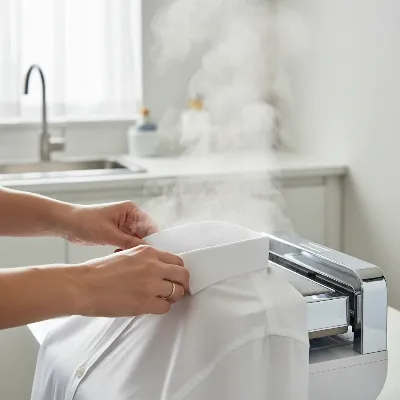 A person precisely pressing the collar of a white dress shirt with a steam press, showing focused attention and steam being released
Maintaining Your Ironing Press for Longevity
- Use Distilled Water: Always use distilled water in your steam press’s reservoir. Tap water contains minerals that can build up over time, clogging steam vents and leaving stains on your clothes.
- Clean the Pressing Plates: Regularly wipe down the pressing plates with a damp cloth (when cool) to remove any residue or starch buildup. Some presses come with specific cleaning instructions or cleaning solutions.
- Empty Water Reservoir: After each use, empty any remaining water from the reservoir to prevent mineral buildup and bacterial growth.
- Proper Storage: Store your ironing press in a clean, dry place. If it comes with a cover, use it to protect the pressing surface from dust and damage.
- Check for Wear: Periodically inspect the padding and cover on your press. Worn or damaged covers can affect performance and potentially damage your garments. Replace them as needed.
> “The secret to an immaculately pressed shirt isn’t just the machine, but the mindful preparation and care you put into each press. Consistency and distilled water are your best allies.” – Sarah Chen, Laundry Care Specialist
Conclusion
Mastering the art of pressing dress shirts with a steam press is a game-changer for anyone seeking a polished, professional appearance with minimal fuss. From understanding the superior benefits a steam press offers over traditional irons—like speed, fabric protection, and consistent results—to selecting the right model for your needs, this guide empowers you with the knowledge to achieve laundry perfection. Remember to consider factors such as size, features, and budget, and always adhere to proper usage and maintenance tips to ensure your press delivers flawless results for years to come. With an ironing press, achieving crisp, wrinkle-free dress shirts is no longer a chore, but an efficient step towards a consistently sharp wardrobe.
Ready to elevate your garment care? What’s the one feature you’re looking for in your next ironing press to perfect your dress shirts?
Frequently Asked Questions
Can a steam press truly replace a traditional iron for all garments?
While a steam press excels at quickly smoothing large fabric areas and providing a crisp finish, a traditional iron might still be preferred for intricate details like pleats, tight corners, or very delicate embroidery that require precise maneuverability. However, for most dress shirts and everyday garments, a steam press offers superior efficiency and results.
How do I prevent shine marks on dark fabrics when using a steam press?
To prevent shine marks, especially on dark or delicate fabrics, always ensure the fabric is slightly damp. Use the appropriate temperature setting, avoid over-pressing, and consider placing a pressing cloth between the garment and the press. The gentle, moist heat of a steam press already reduces the risk compared to a dry iron.
Is a steam press suitable for all fabric types, including delicates?
Many modern steam presses feature adjustable temperature and steam settings that make them suitable for a wide range of fabrics, from sturdy cotton and linen to more delicate materials like silk and synthetics. Always consult the garment’s care label and test on an inconspicuous area first, lowering the steam output and increasing the working distance for fragile fabrics.
How often should I clean my steam press?
It’s recommended to wipe down the pressing plates after each use. For a deeper clean and to prevent mineral buildup in the reservoir and steam vents, flush the system and descale it regularly, depending on your water quality and frequency of use. Using distilled water will significantly reduce the need for frequent descaling.
Can an ironing press really save me time?
Absolutely. Due to its large pressing surface and the simultaneous application of heat and steam, an ironing press can significantly reduce the time spent on laundry. Many users report cutting their ironing time in half, especially for items like dress shirts, trousers, and bed linens, making it a valuable time-saving appliance.
